Anglesey- Public Land Watch
Point Lynas AngleseyJoin our team for a public landwatch at Point Lynas. What3words: fitter.retrieves.enigma



Join our team for a public landwatch at Point Lynas. What3words: fitter.retrieves.enigma
Join our team for a landwatch at Ynys Llanddwyn! How many marine mammals and birds can you spot?
Learn how the Sea Watch Foundation team collects important data! We will provide information on the best ways to spot and identify marine mammals!
Join our team in a marine mammal spotting survey at Porth Tre Castell (Cable Bay) What3Words: cornering.transfers.readers
Join our team for a land watch at Porth Cwyfan! Survey siteWhat3Words: daffodils.contact.emerge Parking What3Words: keep.engraving.slugs
Join our team for a land watch! What3Words: jacket.cabinets.kitkat
Join us for a second evening with marine conservation specialists from around the world! Information on tickets can be found here. Second Evening of Talks: Prof. John Spicer (whale lice and how they work), Dr Peter Evans (the changing world of whales and dolphins), Dr Ewa Krzyszczyk (dolphins of Australia)
Join us online to find out what was seen and where during National Whale and Dolphin Watch 2024!
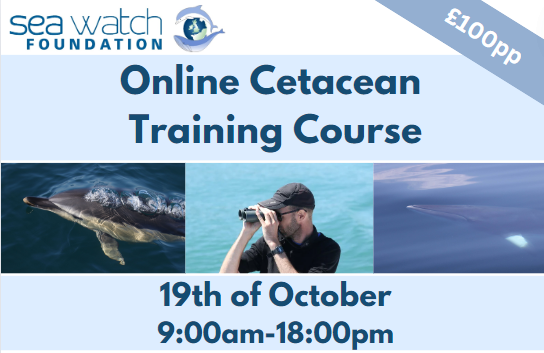
The Sea Watch Foundation is the most experienced organisation in the UK for training observers and students interested in marine mammals, having run courses for over thirty years. It has provided training for staff from all three national statutory conservation agencies, the Environmental Agency, CEFAS, Defra, the Wildlife Trusts, Royal Navy and MMOs working with offshore renewables, and the oil and gas industries. Most of the field guides for cetaceans on the market in the UK have been written or had consultations from the Sea Watch Foundation. We can therefore guarantee a very high level of training, led by highly experienced staff. The lectures and videos will focus on the general biology and classification of cetaceans, species identification, conservation issues facing UK cetaceans and recommended monitoring survey methods. What will you learn? How to identify different cetacean species How to collect data on land and on a boat Why Photo Identification is important and how to conduct Photo ID Cetacean ecology and behaviour Different species of sea birds Conservation and management of cetaceans
Join us online for an exciting evening filled with fascinating discussions about these magnificent marine creatures. Our lineup of speakers includes experts in the field who will share their knowledge and insights with you. Whether you're a seasoned marine enthusiast or just curious about whales and dolphins, this event is perfect for anyone interested in learning more about these amazing animals. Don't miss out on this opportunity to connect with like-minded individuals and expand your knowledge! Date: Time: Location: Online Ticket: Required by donation Register now to secure your spot and get ready for an evening of learning and discovery! The Speakers: Chloe Robinson: The Whale Report Alert System Dr. Chloe Robinson (she/they) is a scientist, conservationist, and science communicator currently serving as Advisor & Technical Lead for the Whales Initiative at Ocean Wise. Her work focuses on using environmental DNA (eDNA) to close data gaps on whales and their prey, with over 25 peer-reviewed publications on non-invasive biodiversity monitoring. Chloe leads the Whale Report Alert System (WRAS), reducing ship strike risk to whales along North America's west coast, and is a passionate advocate for Equity, Diversity, and Inclusion in STEM. She has launched visibility initiatives for 2SLGBTQIA+ scientists, including the Big Gay Whale Watch and university Pride seminar series. Chloe began their cetacean conservation journey as a volunteer with the Sea Watch Foundation (2014–2018), conducting surveys and serving as Regional Coordinator for South Wales. She lives with their wife, son, and cats on the traditional territories of the lək̓ʷəŋən peoples (“Victoria”, Canada). Joe Dennett: The Challenges of Marine Mammal Monitoring Joe's primary focus with Chelonia is the development of the CATT – Cetacean Acoustic Trend Tracking – project. CATT aims to learn lessons on how to implement a low cost and precise means of determining trends using an array of F-PODs around the island of Britain. Many of the stations combine PODs with other instruments deployed as part of other projects. The high level aims of Chelonia Ltd. are Cetacean conservation, research, and education. The CATT project follows these principles adding the concept of local ownership. CATT is delivered by local organisations, groups and communities using loaned equipment with support from Chelonia Ltd. Part of this strategy of local ownership is to avoid the impression that CATT is a Chelonia project or Joe's project, so we try to focus attention on the local communities doing the work. Emily Hague: How Citizen Science Has Contributed to Marine Mammal Research in Scotland Emily is a marine mammal researcher based at UHI Shetland working on the BLUE CONNECT project, to encourage local people and industries in and around Shetland to work collaboratively to understand marine mammals around Shetland. She recently completed her PhD studies at Heriot-Watt University on ‘marine mammals in the Anthropocene’, and for a number of years prior to this worked at the Sea Mammal Research Unit and for SMRU Consulting. Her research largely focuses on how human activities overlap with marine mammals. Her main body of work involves working alongside community-based organisations to work together to improve our understanding of marine spaces, including starting up the ‘Scottish Vessel Project’, to understand vessel traffic and overlap with marine mammals around Scotland in collaboration with WDC and the Hebridean Whale and Dolphin Trust.
Join us online for an exciting evening filled with fascinating discussions about these magnificent marine creatures. Our lineup of speakers includes experts in the field who will share their knowledge and insights with you. Whether you're a seasoned marine enthusiast or just curious about whales and dolphins, this event is perfect for anyone interested in learning more about these amazing animals. Don't miss out on this opportunity to connect with like-minded individuals and expand your knowledge! Date: Time: Location: Online Tickets: Register by donation Register now to secure your spot and get ready for an evening of learning and discovery! Speakers Dylan Coundley-Hughes: Conservation in Storytelling Dylan is a biology graduate and emerging marine science storyteller. This year he was a Period 1 Research Intern with the Sea Watch Foundation, where he had the opportunity to create a nature story based in Wales. He chose to focus on the bottlenose dolphins of New Quay an experience that allowed him to blend science with storytelling to produce a piece Sea Watch can use for outreach and education. Dylan is passionate about visual science communication and hopes to continue developing his skills while championing the role of storytelling in scientific outreach. Erich Hoyt (OBE): Employing Important Marine Mammal Areas to Save Ocean Habitat Erich Hoyt, Whale and Dolphin Conservation research fellow, co-chairs the IUCN Marine Mammal Protected Areas Task Force which is rolling out the ocean conservation tool called ImportantMarine Mammal Areas, or IMMAs. Erich’s books include Creatures of the Deep, Planktonia and Marine Protected Areas for Whales, Dolphins and Porpoises. In 2025, Erich received an OBE for services to marine conservation. Grant Ellis: East Coast of Scotland Bottlenose Dolphins: A Changing Population Grant is a PhD student and researcher at the Sea Mammal Research Unit, University of St Andrews. His research at SMRU over the past 7-years has centred on the ecology ofendangered and protected small cetacean populations to inform knowledge gaps needed for evidence led conservation management. He is also dedicated to promoting engagement in marine science through Citizen Science, art-nature collaborations and public outreach events.Grant’s current collaborative project combines Citizen Science, photo ID surveys and passive acoustic monitoring to investigate the bottlenose dolphins increasingly being spotted in the Northeast of England, and the potential management implications for the ‘East Coast’population.