Applications for 2026 are now Closed
They will open again in November 2026
The Cardigan Bay Monitoring Project is based in New Quay, West Wales, and supports the conservation management of the bottlenose dolphin, harbour porpoise and grey seal populations of Cardigan Bay, monitoring their abundance, distribution, reproductive success and population structure using a combination of vessel-based, land-based and acoustic surveys. Sea Watch Foundation has been monitoring these populations on behalf of the Welsh government (through funding provided by the Countryside Council for Wales, now called Natural Resources Wales) since the 1990s. Cardigan Bay contains Britain’s largest coastal population of bottlenose dolphins, for which two Special Areas of Conservation have been established under the EU Habitats Directive.
Each year we take on interns to help and support our work. This year, our season is from 6th April to 1st November 2026.
RESEARCH INTERN
Research intern application form
Research intern application form
Interns are invited to assist the Sea Watch Foundation (SWF) with the running of the “Cardigan Bay Monitoring Project”. The project is based in New Quay, West Wales, and supports the conservation management of the bottlenose dolphin, harbour porpoise and grey seal populations of Cardigan Bay, monitoring their abundance, distribution, reproductive success and population structure using a combination of vessel-based and land-based surveys. SWF has been monitoring these populations on behalf of the Welsh government (through funding provided by Natural Resources Wales) for two decades. Cardigan Bay contains Britain’s largest coastal population of bottlenose dolphins, for which two Special Areas of Conservation have been established under the EU Habitats Directive. Internships with Sea Watch have frequently led to established posts in national and international research and conservation bodies, as well as providing a stepping stone for students to undertake doctoral studies in marine mammal science. Interns will assist New Quay staff by taking part in the following tasks:
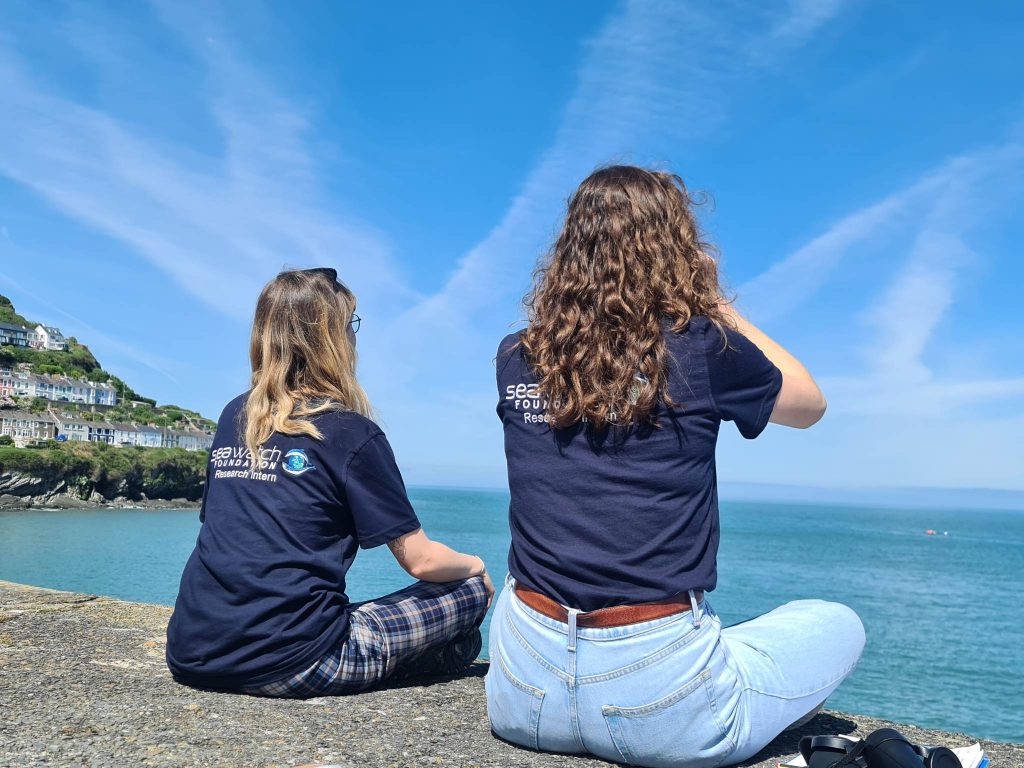
- Land-based surveys
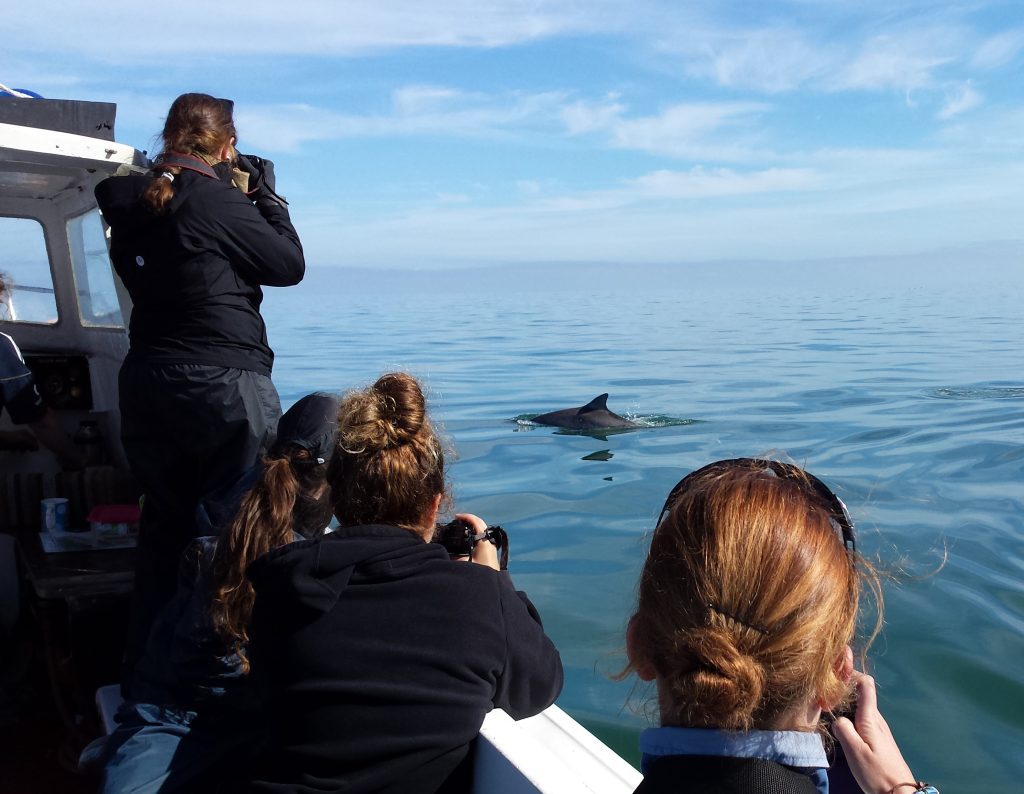
- Boat-based surveys
- Photo-identification matching
- Data entry
- Raising public awareness
- Education initiatives and events
- Assisting with and participation in training courses and other needs of the charity.
Typical office hours are from 10:00 AM to 17:00 PM, with field work falling outside of this. Interns are scheduled on a different weekly office task every week, working on tasks such as sightings entry, photo-identification or public awareness. Fieldwork is weather dependent but interns are scheduled on a daily land based watch as well as a full day of wildlife boat trips once a week. In addition to this, full day line transect surveys for bottlenose dolphins are conducted regularly within the Cardigan Bay and Pen Llyn a’r Sarnau Special Areas of Conservation. Interns are required from early April until the start of November 2026. The research season is split into four separate periods lasting between 7 and 8 weeks. The research periods for the 2026 season are: Period 1: 6th April – 31st May (8 weeks) Period 2: 1st June – 19th July (7 weeks) Period 3: 20th July – 6th September (7 weeks) Period 4: 7th September – 1st November (8 weeks) Interns are expected to arrive on the first day of their chosen period and depart on the first day of the next period. Unfortunately we are not able to change the start and end dates. We encourage applicants to apply for more than one period. Please state in your application which research periods you would like to be considered for and whether you would like to undertake more than one. Interns will be based in New Quay, Ceredigion, West Wales. Accommodation is provided by a private landlord through rental of a house that interns share at a rate of around £82 per person per week. Rooms are shared between two or three people, with a total of nine people in the house at any given time. Please be aware that you may be sharing rooms with people of a different gender. Interns are responsible for their own travel, accommodation and living expenses, but it is generally quite easy to obtain part-time paid work in the area if required. Important skills/qualifications Essential:
- Strong team player, able to work and live comfortably with colleagues in a small rural town
- an ability to work independently in a meticulous and reliable manner
- strong commitment to volunteering work
- willingness to work long hours outdoors in often changeable Welsh weather
- good IT skills (Office package)
Desirable:
- a strong interest and some knowledge of British cetaceans
- a background in marine biology/environmental science or similar
- prior experience in boat-based survey work
- good verbal and written communication skills and in public speaking
- experience in interacting with the public
All interns will be trained in cetacean observation and identification, in boat survey protocols, and photo-identification of bottlenose dolphins. International applications are welcome but applicants require an existing UK visa or be able to obtain a visa independently.
PLEASE NOTE: We are unfortunately unable to provide sponsorship for the UK Charity Worker Visa scheme and cannot provide advice on visa applications.
If you are interested in this position, please contact Katrin Lohrengel on katrin.lohrengel@seawatchfoundation.org.uk with a completed Research Intern application form and CV by 9th February 2025. Decisions will be made by end of February 2025.
Potential funding sources to support your internship with Sea Watch
SWF is aware that undertaking unpaid work can be challenging, however, as a small charity we are currently not able to offer compensation for internships. There are some outside funding bodies that may be able to help you fund your internship. If you are accepted for an internship, we are happy to provide letters to support your funding application.
If you are a current student or recent graduate it is worth checking whether your university offers financial support for students undertaking field work related to their degree subject.
This site offers a comprehensive list of potential grants to apply for here
RESEARCH ASSISTANT AND INTERN COORDINATOR
Research assistant application form
Applications for 2026 are now closed.
Sea Watch Foundation (SWF) are looking for a Research Assistant and Intern Coordinator to assist with the running of the “Cardigan Bay Monitoring Project”. The project is based in New Quay, West Wales, and supports the conservation management of the bottlenose dolphin, harbour porpoise and grey seal populations of Cardigan Bay, monitoring their abundance, distribution, reproductive success and population structure using a combination of vessel-based and land-based surveys. SWF has been monitoring these populations on behalf of the Welsh government (through funding provided by Natural Resources Wales) for two decades. Cardigan Bay contains Britain’s largest coastal population of bottlenose dolphins, for which two Special Areas of Conservation have been established under the EU Habitats Directive. Internships with Sea Watch have frequently led to established posts in national and international research and conservation bodies, as well as providing a stepping stone for students to undertake doctoral studies in marine mammal science.
Research assistant responsibilities will include, but are not limited to:
- Coordination between the Monitoring Officer and project interns – in charge of the intern shared house and the intern weekly office rota.
- Assisting the Monitoring Officer & Sightings Officer in training interns and other volunteers in land- and boat based surveys, photo ID studies, database entry, and more.
- Assisting the Monitoring Officer in all phases of the research.
- Assisting the Sightings Officer with maintenance of the national sightings network.
- Optional opportunity to undertake a personal research project supervised by the Monitoring Officer. Research topic will be chosen according to Sea Watch Foundation requirements and applicant’s interests.
This is a seasonal position and will run from 30th March to the 10th November 2026. The Research Assistant is expected to work 5 days a week with office hours running from 9AM to 6PM with an hour lunch break although field work regularly falls outside of office hours. The Research Assistant will take part in both field and office based tasks such as land based watches, opportunistic surveys on wildlife trips and full day line transect surveys. Apart from supervising interns and creating rotas, photo-identification and sightings management will be a large part of RA duties when in the office. The Research Assistant is entitled to one week’s holiday during the season, the dates of which should be agreed upon at the start of placement if at all possible. We will be providing a bursary of £5,000 through the Tallie Brazier scholarship again this year. The bursary is provided through the generosity of the Brazier family, in memory of our former intern Tallie Brazier, and is meant to go towards living expenses over the 6 months they work with the Sea Watch Foundation. More information below. Accommodation will be provided free of charge in the shared intern house.
Requirements:
- The successful applicant is expected to have completed a BSc degree (or higher) in biology, marine biology, zoology, chemistry, or related field and able to demonstrate previous experience in marine mammal research.
- A strong interest and knowledge of British cetaceans and experience are beneficial.
- The applicant should ideally have some experience using DSLR cameras.
- Practical experience of photo-identification (both photography and matching) is desirable.
- Experience with other equipment regularly used by Sea Watch Foundation such as hydrophone, polecam, theodolite, digiscope and aerial camera drone is advantageous.
- The applicant must be proficient with database and word processing software and be willing to learn new software applications.
- Specific experience in use of Access and GIS would be advantageous.
- The preferred candidate should have a proven track record as a team player.
- The Research Assistant will be working in tightly knit team with the three New Quay based SWF staff members as well as coordinating a team of at least 8 interns.
- The Research Assistant and interns live and work together on a daily basis which requires a high degree of interpersonal skills, tact and a good sense of humour to maintain positive relationships and team morale.
- Previous experience working successfully in similar roles is essential.
- Applicants must be self-motivated, with the drive and determination to work independently and responsibly without direct supervision.
- The work load is varied and therefore a high degree of organisation, attention to detail, and ability to prioritise are essential.
- If a personal research project is undertaken, this brings the opportunity to submit work for scientific publication, and for presentation at the European Cetacean Society Conference.
This position is unpaid but (shared) accommodation will be provided in the intern house. The successful applicant will be granted a bursary of £5,000 and (shared) accommodation will be provided in the intern house free of charge. Please note that if the applicant leaves earlier than initially agreed to, the remainder of the bursary will need to be repaid to the Sea Watch Foundation and Tallie Brazier fund. The Research Assistant will be responsible for their own travel expenses to New Quay but travel undertaken as part of the internship will be reimbursed. International applications are welcome but it is the applicant’s responsibility to ensure visa requirements are met. Sea Watch is not able to sponsor applications. Your chosen visa option should be highlighted in the application form and you will be expected to provide information on this if you are selected for an interview.
If you are interested in this position, please contact Katrin Lohrengel on katrin.lohrengel@seawatchfoundation.org.uk with the completed Research Assistant application form, CV and details of two references by 31st January 2026. Decisions will be made by end of February 2026.
APPLICATIONS FOR 2026 ARE NOW CLOSED
Potential funding sources to support your internship with Sea Watch
SWF is aware that undertaking unpaid work can be challenging. However, as a relatively small charity it is currently not able to offer compensation for internships. However, there are some outside funding bodies that may be able to help you fund your internship. If you are accepted for an internship, we are happy to provide letters to support your funding application.
If you are a current student or recent graduate it is worth checking whether your university offers financial support for students undertaking field work related to their degree subject.
This site offers a comprehensive list of potential grants to apply for: Gap Year Funding list
EDUCATION AND OUTREACH ASSISTANT ROLE
Applications for 2026 are now closed.
Based in New Quay (West Wales), our Education and Outreach Assistant is the often the first face for visitors to our Visitor and Education Centre. This position suits a volunteer with a strong interest in marine conservation that recognises the importance of educating and raising awareness by involving all ages. Our Communication and Outreach Officer will provide support and supervision for this position.
The Education and Outreach Assistant will be responsible for the following duties:
- Running the Visitor and Education Centre in New Quay: coming up with activities and and events to draw visitors in as well as day to day maintenance.
- Raising Sea Watch Foundation’s profile locally. This will involve liaising with local boat operators and businesses, organising events and producing educational materials to raise awareness. You will work closely with our boat operator in New Quay to ensure promotion of Sea Watch Foundation on their trips by providing educational materials and training interns to speak about Sea Watch during trips.
- Organising, promoting, and delivering National Whale and Dolphin Watch education and outreach activities. Creating and running daily activities in New Quay, creating social media content throughout the week and in the lead up to. More information about NWDW can be found here.
- Contacting schools and organising trips. Working alongside our Communication & Outreach Officer you will participate in presentations and create activities to take/deliver to local schools and groups.
- Creating educational/promotional materials such as online learning resources, flyers and updating our Daily Sightings board.
- Managing social media (Facebook, Twitter, Instagram, TikTok) and blog posts in association with the Communications & Outreach officer.
- Representing Sea Watch Foundation at local public events.
- Supervising our Public Awareness intern. Each week you will be joined by an intern to help with your duties and deliver activities/events.
- Assisting the Communications & Outreach Officer with grant applications.
The field will run from 6th April to 1st November 2026. Our preferred Education and Outreach Assistant will stay for the whole season but, applicants can apply for half of the season (choosing Period 1-2 or 3-4). The assistant will be based in New Quay, West Wales, and expected to work 5 days a week (typically including one weekend day) from 10am to 5pm.
Period 1: 6th April – 31st May (8 weeks) Period 2: 1st June – 19th July (7 weeks) Period 3: 20th July – 6th September (7 weeks) Period 4: 7th September – 1st November (8 weeks)
Accommodation will be provided free of charge in the shared intern house.
The Education and Outreach Assistant will be responsible for their own travel expenses to New Quay but travel undertaken as part of the internship will be reimbursed.
Important skills/qualifications Essential:
- A strong interest in marine conservation and education
- Outgoing and confident with experience in public awareness
- Some experience of working with children/young people
- Excellent verbal and writing skills
- Public speaking
- Social media
- Ability to work to their own initiative and independently in a organised and reliable manner
- Ability to work in busy periods and multitask
- Ability to delegate within a small team
Desirable
- Background in marine biology/environmental science or similar
- Strong interest and some knowledge of British marine mammals
- Good IT skills (Office package and WordPress)
- Willingness to work long hours, sometimes outdoors in very changeable Welsh weather
International applications are welcome but it is the applicant’s responsibility to ensure visa requirements are met. Sea Watch is not able to sponsor applications. Your chosen visa option should be highlighted in the application form and you will be expected to provide information on this if you are shortlisted.
If you are interested in this position, please contact Harriet Goodchild on harriet.goodchild@seawatchfoundation.org.uk with a cover letter, CV and details of two references by 31st January 2026. Decisions will be made by end of February 2026.
APPLICATIONS FOR 2026 ARE NOW CLOSED
NATIONAL WHALE & DOLPHIN WATCH ASSISTANT
Each year the Sea Watch Foundation seeks National Whale and Dolphin Watch Assistants for the upcoming season. This position will suit volunteers who have a strong interest in marine conservation and recognise the importance of educating and raising awareness by involving the public. The assistants will be responsible for aiding the Sightings Officer and Communications and Outreach Officer with the following duties:
- Promoting, organising and running the National Whale and Dolphin Watch event
- Creating promotional materials (flyers) for dissemination around the UK
- Social networking (Facebook, Twitter, Instagram, website) before and during the event
- Interacting with the media (radio, TV and newspapers), including preparing press releases
- Using initiative and creativity to reach out to wider audiences
- Keeping records of planned events
- Updating webpage with events
- Posting observer packs to participants in a timely manner
- Encouraging data submission and website updates during the event
- Collating data and imagery from the event
- Entering event data on to database template
The National Whale and Dolphin Watch Assistants will also have some opportunity to be involved in land-based and boat-based watches. However, this will be dependent on workload and will be decided by the Sightings Officer each time the opportunity arises. The chosen National Whale and Dolphin Watch Assistant(s) can work on-site, remotely or a combination of both. Dates for NWDW 2025 are the 26th of July to 3rd of August. The successful candidate(s) will need to be available from beginning of July to the end of August and be able to commit to 5 days a week before and after the event and for the whole 9 days of the event. Important skills/qualifications Essential:
- A strong interest in marine conservation and education
- Strong commitment to volunteering work
- Excellent verbal and writing skills
- An ability to work in an organised and reliable manner and to manage a variable workload, including appropriate delegation
- Good IT skills (Office package)
- A careful, meticulous worker comfortable with entering quantities of sightings data accurately
- Outgoing personality with confidence to interact with the public
Desirable:
- Experience of events organising
- Experience with postings on social media
- Prior experience in public speaking
- A strong interest and some knowledge of British cetaceans
- Willingness to work outdoors in often very changeable Welsh weather
With this position we offer:
- Experience working with the general public organizing local events
- Experience delivering flexible interactive online or face-to-face presentations to adults as part of our online training programme
- Chances to learn and develop effective communication skills
- Training in marine education & conservation and in identifying coastal marine species
- The experience of working for a charity in a busy office environment
- Training in survey techniques (land- and boat-based)
- Experience in scientific report writing
- The experience of preparing and disseminating news releases for the media on major stories of environmental interest and writing articles for specialist magazines
- Experience in obtaining event sponsorship
Find out more about National Whale and Dolphin Watch here!
Applications are now closed.
THE TALLIE BRAZIER SCHOLARSHIP
During the 2023 season, Sea Watch Foundation were joined by a bright and bubbly individual, Tallie Brazier. Tallie tragically passed away in 2024, leaving her family and all that knew her distraught. As a way to remember Tallie, the Brazier family set up an annual football tournament, titled “The Tallie Brazier Cup”, to raise money to continue making an impact in the world. Tallie’s passion for and commitment to marine conservation was nothing less than inspirational. Thanks to the generosity of the Brazier family, the Tallie Brazier Scholarship has been created. Sea Watch Foundation will continue to honour and remember Tallie, and all that she has done for the marine world.
We hope to provide a bursary of £5,000 to the Research Assistant through the Tallie Brazier scholarship again this year, however, cannot confirm this at time of advertising. The bursary is provided through the generosity of the Brazier family, in memory of our former intern Tallie Brazier, and is meant to go towards living expenses over the 6 months they work with the Sea Watch Foundation.
*Please note that if the applicant leaves earlier than initially agreed to, the remainder of the bursary will need to be repaid to the Sea Watch Foundation and Tallie Brazier Scholarship*
Late intern, Tallie Brazier, on a wildlife trip in New Quay in 2023.
About Sea Watch Foundation
For the past 30 years, Sea Watch Foundation has been monitoring the dolphins, porpoises and whales around the UK, documenting abundance trends, identifying conservation threats, and advising on the best ways to protect regional populations. Alongside its own scientific surveys and research, Sea Watch has for more than a quarter of a century pioneered citizen science as well as run a range of education and outreach programmes. It is the longest-running research charity in the UK focusing upon cetaceans around the British Isles, and maintains a national sightings database, the largest in Europe. It works closely with all the UK statutory conservation agencies, and has provided advice to the UK government, the UNEP Regional inter-governmental Conservation Agreement – ASCOBANS, and the European Commission, as well as the major conservation charities and marine industries operating in the UK.
Public awareness
We aim to raise awareness and understanding of the importance of marine species and the habitats supporting them, to encourage respect and conservation of the marine environment for future generations. We also run training courses for the public in cetacean identification and survey methods.
A list of some science, awareness and education achievements is given below:
- Sea Watch Director, Dr Peter Evans, received the European Cetacean Society Conservation Award, 2012
- Sea Watch Foundation was recipient of the UNEP/ASCOBANS Outreach and Education Award, 2009
- Sea Watch Foundation was voted best UK animal adoption scheme by BBC Wildlife, December 2008
- Publication of Evans, P.G.H. (2019) European Whales, Dolphins and Porpoises. Marine Mammal Conservation in Practice. Academic Press, London & San Diego. 306pp.
Jing Di Ong
“Fantastic place to meet new people and experience a career in marine mammal research and conservation!”
Sian Tustin
“A beautiful environment that allowed me to learn more about such fascinating creatures. Super hands-on and encouraging work! I couldn’t recommend it more!”
Sarah Wares
“The most hands on experience with learning as the priority. Very motivating environment, pushing you to get involved and have fun! I learnt more here about cetaceans than in my undergraduate degree!”
Tom Davies
An outstanding hands-on experience in a supportive, inspiring environment that pushed me beyond my comfort zone.