
Oct 31, 2025
By Intern: Alana Zammit
In the spirit of our spookiest season, Halloween, I would like to introduce you all to some of the more unusual looking creatures that roam our vast ocean.
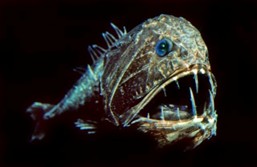
First up, we have the very aptly named fangtooth fish. With the largest teeth in the ocean (proportionally), the fangtooth has evolved specialised sockets on both sides of their brains so that they can *almost* close their mouths. There are actually two species of fangtooth, the common fangtooth (Anoplogaster cornuta) and the shorthorn fangtooth (Anoplogaster brachycera). Both live at depths of up to 5000m, where they feast on fish and any crustaceans they can find. In addition to their impressive teeth, Fangtooths can also detect motion and pressure changes using their lateral line organ. All in all, they are rather impressive fish!
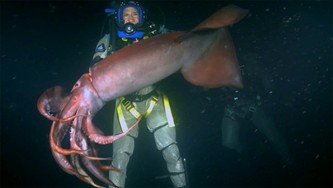
Next up, we have the Humboldt squid. The Humboldt squid, whilst smaller than the giant squid, is not one to be overlooked when it comes to providing the fear-factor. They can thrust themselves through the water at speeds of up to 24km/h, and hunt using two tentacles lined with 200 suckers, each with razor sharp teeth (each animal may have up to 24,000 teeth in total). As well as their two vicious tentacles, they have eight shorter arms that they use to hook and pull their prey towards their sharp, powerful beak. Whilst they primarily feed on fish, there have been accounts of Humboldt squid attacks on people. In the Sea of Cortez, Mexico, they have been given the title of ‘Diablo Rojo’, meaning the Red Devil, from accounts of fishermen disappearing into the grasps of the Humboldt squid. What makes them even more terrifying is the fact that these squid tend to move and even hunt in groups, with shoals estimated to reach up to 1200 individuals! However terrifying they may be to us, we are still far more dangerous to them. Humboldt squid are one of the most heavily fished squid species globally: everyday, fisherman in Mexico catch up to 300 tons of Humboldts, with no signs of relenting. Due to the scarcity of population size data, we are unsure how Humboldts are coping with such a magnitude of fishing, but it seems unlikely that any species could maintain a viable population size with so many deaths daily.
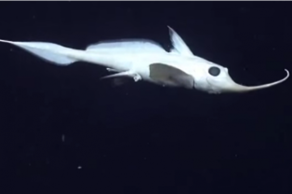
Next, arguably more cute than spooky, is the ‘spookfish’, a new species of ghost shark discovered in the deep waters off New Zealand. The spookfish has big round eyes and a long, pointy nose which it uses to hunt for octopuses, crabs, and other species that live on the ocean floor. To ward off predators, ghost sharks have a large, jagged spine on their dorsal fin. Ghost sharks are also fascinating as ‘living fossils’, in that they have not changed much since they evolved around 375 million years ago, during the Carboniferous period.
Last but not least, we have the goblin shark. Perhaps most notable about goblin sharks is their rather unusual looking noses, which protrude out from their body and are packed with electroreceptors ready to detect their prey in the darkness. To catch their slippery fish food, they have a rapidly extending jaw, which then passes the food to an also-expandable mouth and throat! The goblin shark has a relatively weak, atrophied body, with small fins and poorly developed muscular and visual systems. It is therefore thought that their special jaws are an adaptation to enable them to hunt despite their relatively weak bodies. However, they are deep-sea creatures, and are rarely caught, so very little is still known about them.

All the species discussed below live in our deep seas, where the eternal darkness and immense pressure allow for the most weird and wonderful evolutionary feats! What is even more exciting is that we have seen less than 0.001% of the deep ocean seafloor, so chances are high that there are many more fascinating creatures to be discovered in the years to come.
References:
https://factanimal.com/fangtooth/
https://fity.club/lists/suggestions/fangtooth-fish/
https://factanimal.com/humboldt-squid/
https://goodheartextremescience.wordpress.com/2010/01/04/the-red-demons-of-the-sea-of-cortez/
https://animalofthings.com/humboldt-squid/
https://www.nationalgeographic.com/animals/article/new-species-ghost-sharks-new-zealand
https://factanimal.com/goblin-shark/
https://www.coolkidfacts.com/goblin-shark-facts/
https://oceanexplorer.noaa.gov/ocean-fact/explored/
