Apr 12, 2021
By: Megan
We are rapidly approaching peak minke whale season! Although minke whales can be seen year-round, they are most frequently spotted along the U.K coastlines bordering the North Sea between April and October. Despite their typically shy behaviour, minke whales are a favourite of whale-watchers to observe due to their specialised feeding behaviours and their ability to make surprising acrobatic leaps from the surface.
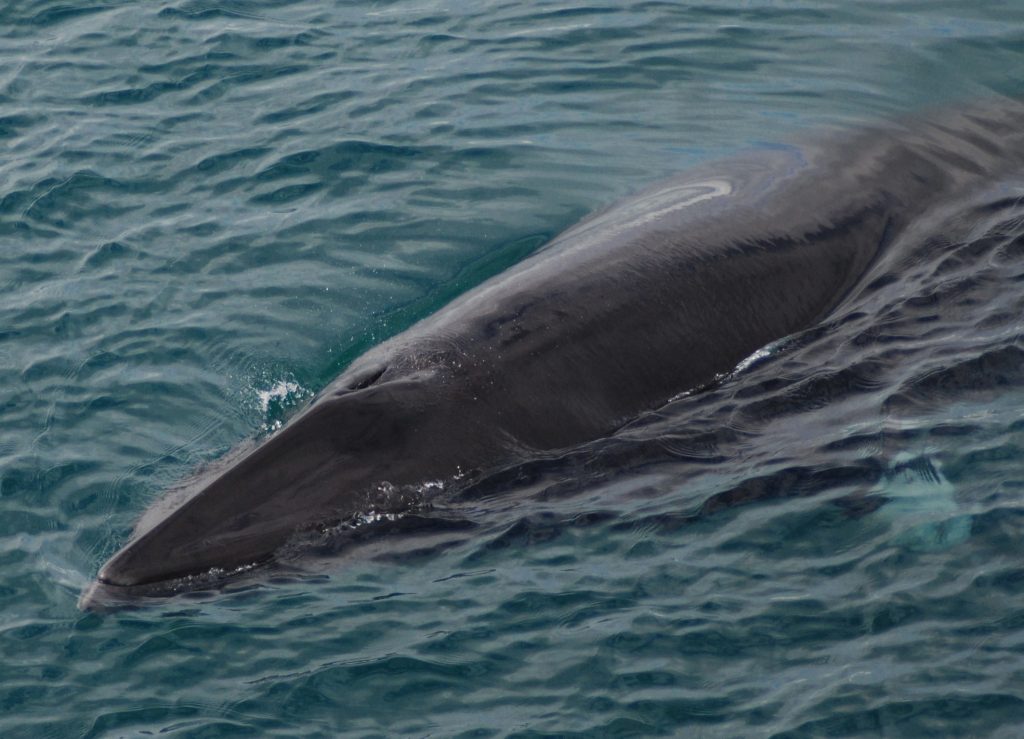
“I have studied minke whales for almost a decade and I find them incredibly interesting. Their intricate behavioural repertoire and their curious yet elusive nature, drive me towards understanding more about this overlooked species.”
Dr. Chiara G. Bertulli, Sightings Officer
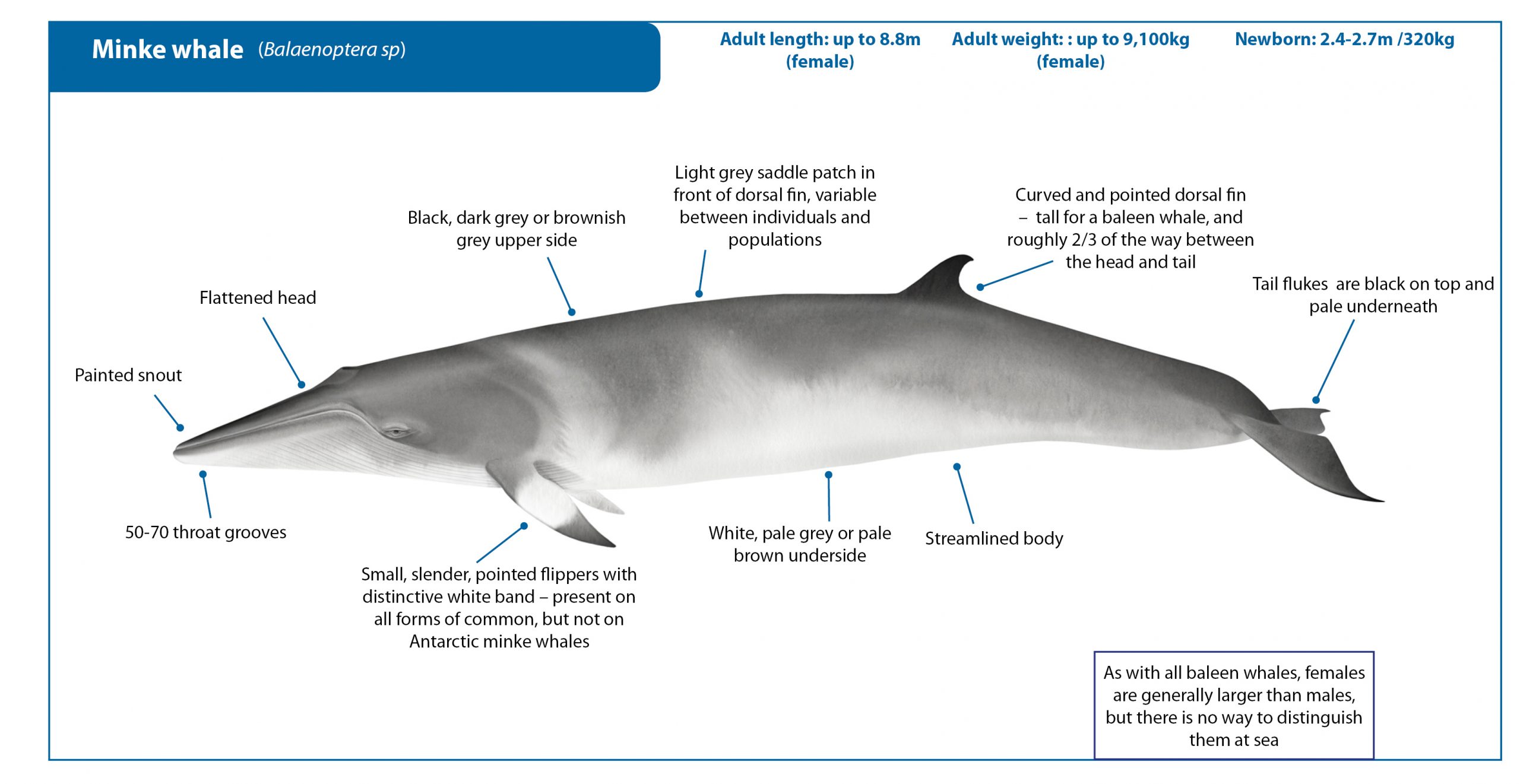
Minke whales are the most abundant baleen whale globally. In adulthood, they measure between 7.8-9m long on average, and weigh between 5,400-6,800kg. They are the smallest baleen whales found in the Sea Watch study area. In the Northern Hemisphere, there are two described subspecies of minke whale: Balaenoptera acutorostrata scammoni and Balaenoptera acutorostrata acutorostrata. The former is found in the North Pacific, and the latter is found in the North Atlantic. Populations differ in coloration and size, but are generally characterised with a pointed snout, flattened head, and a light chevron on their back.
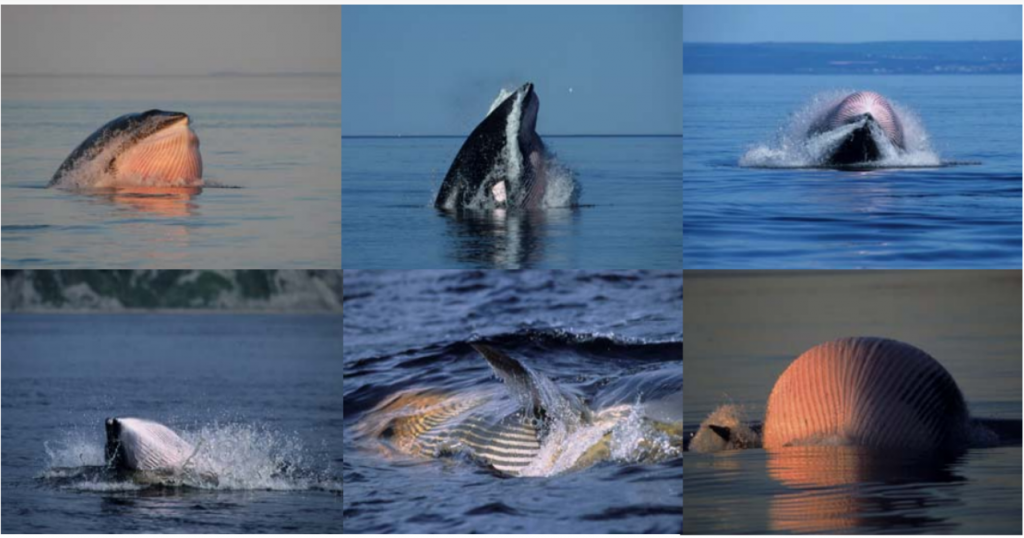
Minke whales do not typically lift their flukes above the surface when they dive. Their discreet behaviour makes them difficult to spot among the chaotic ocean waves even when they surface to breathe. However, due to their small stature, they can make breathtaking breaches from the surface completely unannounced. In many cases, these acrobatic leaps are a means to feed. Like all baleen whales, minkes feed by lunging into a concentration of schooling fish or krill with their mouths wide open. They then filter out the water, and trap the prey in between their baleen plates.
For easier prey capture, minke whales employ a variety of specialised lunges. Some minkes have been found to take advantage of flocks of birds preying on schools of fish and lunge-feed from below. Minkes have also been documented to make ventral, oblique, lateral, and vertical lunges. In fact, when a study performed by Kot et al. (2014) compared the diversity in feeding tactics of minkes, fin whales, and blue whales, minkes presented the most diverse foraging repertoire. Each individual minke whale has its own unique behaviour profile, and many can be identified by their feeding strategies alone. Researchers suspect that the minke whales’ high site fidelity has resulted in foraging specialisations acquired to better exploit prey according to their density, type, and the topography of their habitat.
While minke whales are currently listed as “least concern,” on the IUCN red list for endangered species, scientific efforts to aid in their conservation have not ceased. Maintaining stable numbers of minke whales is essential for organisms along the entire food web. You can do your part to conserve minke whale populations by reporting sightings to our sightings form! By creating an accurate report of minke whales in our area, we can better understand how environmental factors and human activities influence their populations over time, and facilitate tailored approaches to their conservation.
Sources
- Evans, P. G. H., & Waggitt, J. J. (2020). Impacts of climate change on Marine Mammals, relevant to the coastal and marine environment around the UK. MCCIP Science Review 2020, 420-454.
- Hoelzel, A. R., Dorsey, E. M., & Stern, S. J. (1989). The foraging specializations of individual minke whales. Animal Behaviour, 38(5), 786-794.
- International Whaling Commission (n.d.). Minke whale – Balaenoptera acutorostrata and B. bonaerensis
- Kot, B. W., Sears, R., Zbinden, D., Borda, E., & Gordon, M. S. (2014). Rorqual whale (Balaenopteridae) surface lunge‐feeding behaviors: Standardized classification, repertoire diversity, and evolutionary analyses. Marine Mammal Science, 30(4), 1335-1357.
- The MarineBio Conservation Society (n.d.). Minke Whales, Balaenoptera acutorostrata.
- NOAA Fisheries. (n.d.). Minke Whale.
- Risch, D., Wilson, S. C., Hoogerwerf, M., van Geel, N. C., Edwards, E. W., & Brookes, K. L. (2019). Seasonal and diel acoustic presence of North Atlantic minke whales in the North Sea. Scientific reports, 9(1), 1-11.
- Tscherter, U., & Morris, C. (2007). Individual site fidelity and novel feeding strategies of minke whales: A summary of research results. In Proceedings of the workshop: An integrated approach to non-lethal research on minke whales in European waters. Eds. Robinson, KP, Stevick, PT and CD MacLoed. ECS Special publications (No. 47, pp. 14-22).
- The Wildlife Trusts. (n.d.). Minke Whale.
